
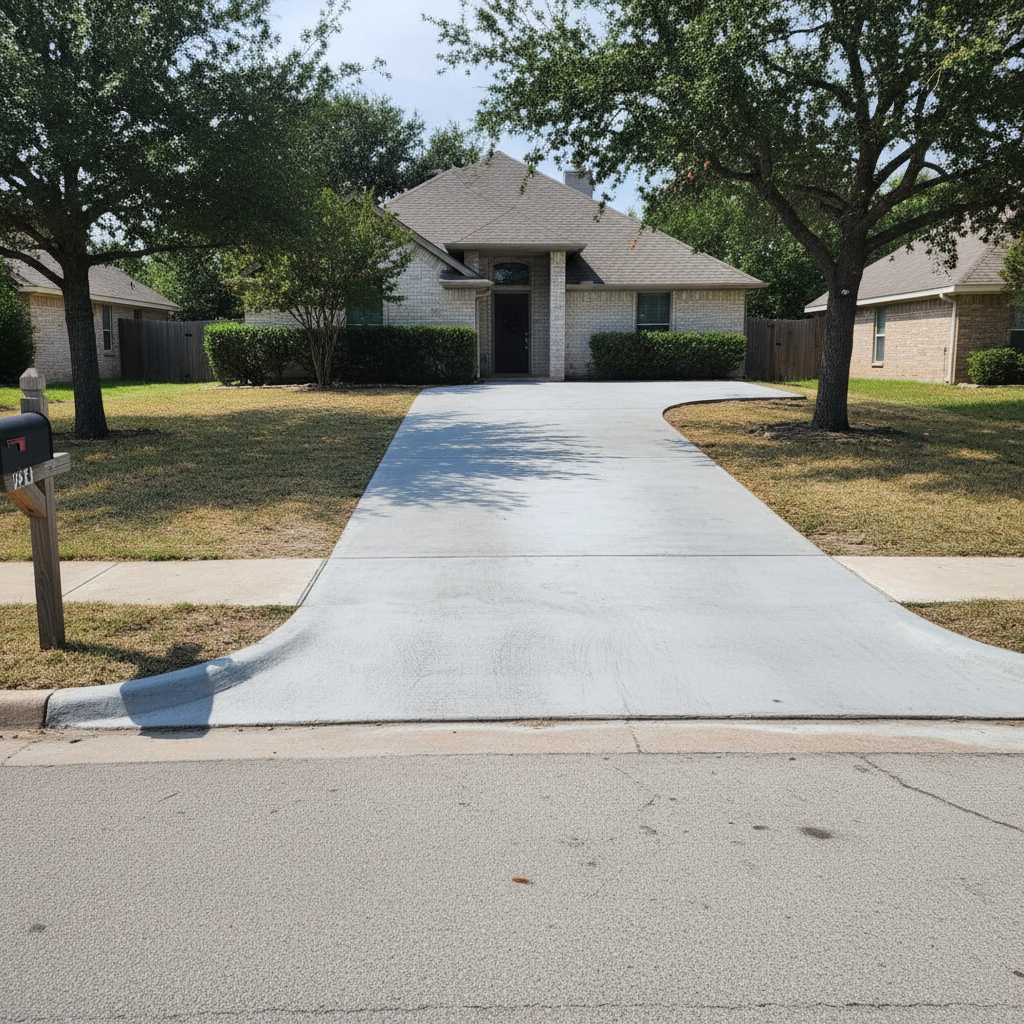
Mesquite sits on blackland prairie clay, the same heavy, dark soil that runs through most of North Texas. It swells when it's wet and shrinks hard when it dries out, and that movement is why so many driveways and patios around here crack, heave, or settle within a few years of being poured. A contractor who doesn't account for that isn't giving you a lower price, he's giving you a problem with a five-year fuse. Picking the right person for a concrete job matters more here than it would in a place with stable, sandy soil, because the ground itself is working against the slab.
Check the license and insurance before you look at the price
Texas doesn't require a special state license for concrete work the way it does for electrical or plumbing, so there's no license number to verify the way you might with those trades. What you can and should check is general liability insurance and workers' comp coverage. Ask for a certificate of insurance, not a verbal yes. If a crew is on your property with a mixer truck and a bobcat and someone gets hurt, you don't want that liability landing on your homeowner's policy. A contractor who hesitates to produce proof of coverage is telling you something.
A real bid tells you the thickness, the mix, and the reinforcement
A vague quote says "we'll pour you a nice driveway." A real one spells out numbers. For a standard residential driveway you're looking at 5 to 6 inches of concrete, not 4, because it has to carry vehicle weight over time. Patios, sidewalks, and porch slabs can run thinner, usually 4 inches. The mix strength matters too. Most residential flatwork around Mesquite should be 3,500 to 4,000 PSI, not the 2,500 to 3,000 PSI mix that's cheaper and fine for a shed pad but not for something cars sit on.
Ask whether they're using rebar or wire mesh. Mesh is lighter, cheaper, and fine for some jobs, but it tends to sag to the bottom of the pour where it does almost nothing. Rebar, typically #3 or #4 bar on 18- to 24-inch centers, actually holds the slab together when the clay underneath shifts. For driveways and anything load-bearing, rebar is worth asking about specifically, not just assuming it's included.
Ask what they're doing about the ground, not just the concrete
This is the part a lot of homeowners skip, and it's the part that decides whether the slab lasts 10 years or 30. Before any concrete goes down, the base matters. A compacted base of 4 to 6 inches of crushed limestone or recycled concrete gives the slab something stable to sit on and helps water drain instead of pooling under it. On the heavier clay lots, especially in older parts of Mesquite like the areas near downtown and along Scyene Road where homes went in during the 1960s and 70s, the sub-grade sometimes needs extra prep or even a bit of excavation and re-compaction before the forms go up. A contractor who skips straight from "we'll clear the old slab" to "we'll pour" without mentioning the base is skipping the step that actually matters most on this soil.
If you're dealing with an existing slab that's already settled or tilted, ask whether mudjacking or polyurethane foam leveling makes sense before you pay for a full tear-out and repour. Clay shrink-swell is the usual cause of that kind of settling, and sometimes lifting and stabilizing the existing slab is a faster, cheaper fix than starting over.
Permits, inspections, and timing in Mesquite
Most driveway, patio, and slab work in the city requires a permit, especially if you're replacing a large section or the work touches the right-of-way near the street. The city inspects forms and reinforcement before the pour, sometimes called a pre-pour inspection, so the steel has to be in place and the base has to be compacted before the truck shows up. A contractor who tells you permits aren't necessary, or who wants to pour before an inspection is scheduled, is cutting a corner that can come back on you if you ever sell the house and a buyer's inspector asks for permit history. If you're in one of the newer subdivisions out toward Sunnyvale or Forney, check whether your HOA has its own approval process for things like pool decks or retaining walls, separate from the city permit. Older Mesquite neighborhoods generally don't have an HOA layer to deal with, which simplifies things.
What to walk away from
A few signs are worth taking seriously.
- No written contract, just a handshake and a start date.
- Full payment demanded upfront. A deposit is normal. All of it before work starts is not.
- They can't tell you the PSI of the mix or the slab thickness when you ask directly.
- No mention of cure time. Concrete needs about 24 to 48 hours before foot traffic and closer to 7 days before you drive on it, and a contractor who tells you it's fine to park a car on it the next morning either doesn't know better or doesn't care.
- A bid that's noticeably lower than two or three others with no explanation. That gap is usually coming out of the base prep or the reinforcement, and you won't see the difference until the first wet winter after a dry August.
Texas summers push temperatures past 100 degrees for weeks at a stretch, which speeds up curing and means timing and water control during the pour actually matter. Winters bring the occasional ice event and enough freeze-thaw cycling to stress a slab that wasn't finished or jointed correctly. Control joints should be cut within 24 to 48 hours of the pour, spaced roughly two to three times the slab's thickness in feet, so the concrete cracks along a line you chose instead of wherever it wants to.
A contractor who answers these questions without hesitating has probably poured a lot of concrete on this clay before. That's the person you want. If you're weighing a driveway, a patio, a repair, or anything else in this trade, you can see the kind of work we do at Solidcore Concrete Works.